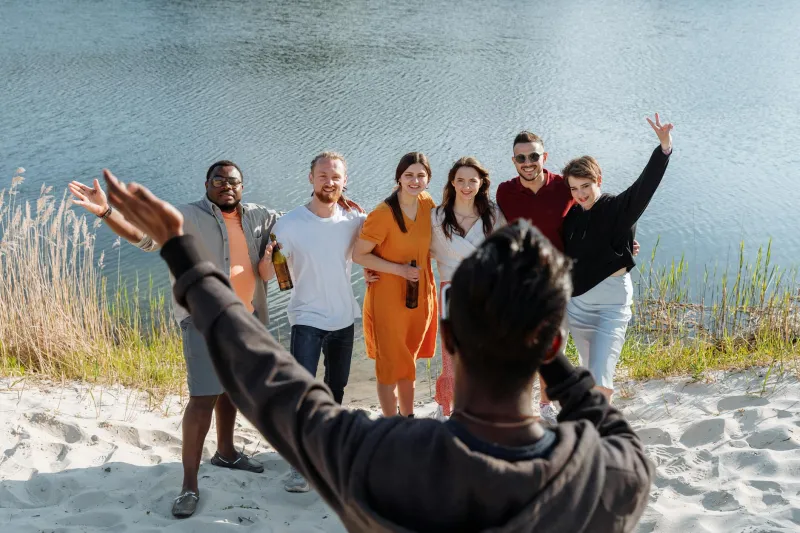
Remember when celebrity friendships used to be, you know, private? When famous people could grab coffee without it becoming a coordinated photo opportunity complete with matching outfits and strategic paparazzi positioning? Those days are deader than flip phones, and in their place, we've got something far more calculated: the celebrity friendship industrial complex.
The Taylor Swift Blueprint
Let's start with the master class: Taylor Swift's ever-evolving inner circle. From her 2014-2016 squad era featuring Gigi Hadid, Karlie Kloss, and Selena Gomez, to her current crew of Blake Lively, the Haim sisters, and Phoebe Bridgers, Swift has perfected the art of strategic friendship curation. Each friend serves a purpose: Gigi brings high fashion credibility, Blake adds Hollywood legitimacy, Phoebe provides indie cred.
But here's what's fascinating: these friendships seem to ebb and flow with Swift's career needs. Notice how her pop era friends mysteriously faded when she pivoted to folklore's indie aesthetic? How her current circle perfectly aligns with her sophisticated, literary rebrand? It's almost as if someone's sitting in a boardroom mapping out which friendships serve which narrative.
The Mutual Benefit Society
The dirty little secret about celebrity friendships? They're often more beneficial than any formal business partnership. When Hailey Bieber hangs out with Kendall Jenner and Justine Skye, she's not just having girl time—she's accessing their combined 500 million followers, cross-pollinating fan bases, and creating content that keeps all three of them trending.
Take the recent surge in celebrity "girls' trips" to places like Saint-Tropez or the Hamptons. These aren't spontaneous getaways; they're multi-day content creation opportunities. Every sunset photo, every candid laugh, every "casual" beach walk is being documented by professional photographers who just happened to be in the neighborhood. The resulting images get sold to magazines, shared across social platforms, and generate millions in equivalent advertising value.
The Paparazzi Coordination Game
Let's talk about those "candid" friendship photos that mysteriously show up in tabloids. You know the ones: perfectly lit shots of celebrities looking effortlessly gorgeous while doing something mundane like getting smoothies or walking their dogs together. These images don't happen by accident.
Sources in the entertainment industry confirm what we've all suspected: many of these paparazzi encounters are coordinated through publicists. The location is chosen for optimal lighting and backdrop, the timing ensures maximum media pickup, and sometimes the photographers are even provided with specific shot lists. It's friendship theater, performed for an audience that's desperate to believe in authentic celebrity connections.
The Rhode Island Test
Taylor Swift's annual Fourth of July parties at her Rhode Island mansion became the gold standard for celebrity friendship performance art. The guest list read like a who's who of young Hollywood, the Instagram content was perfectly coordinated, and the cultural impact was enormous. But notice what happened when Swift stepped back from public squad displays? The Rhode Island parties quietly disappeared, and suddenly, many of those "best friends" were nowhere to be found.
This pattern repeats across celebrity friend groups. When the central figure's star power wanes or their brand shifts, the friendships often follow suit. It suggests these relationships might be more transactional than transformational.
The Zendaya Exception
Not every celebrity friendship follows this calculated model. Zendaya's inner circle—including her longtime assistant and best friend Darnell Appling, her Euphoria co-stars, and her Spider-Man family—feels notably different. These relationships predated her A-list status, survived her transition from Disney to serious actress, and don't seem to shift based on her career needs.
The difference is telling. Zendaya's friendships feel authentic because they were formed organically, not assembled for maximum strategic benefit. When she hangs out with Tom Holland or posts about her assistant, it reads as genuine affection rather than brand management.
The Social Media Friendship Performance
Instagram has turned celebrity friendships into a performance medium. Every birthday post, every "girls' night" story, every carefully crafted group photo serves multiple purposes: it reinforces the friendship narrative, generates engagement, and keeps both parties relevant in the algorithm.
But this constant documentation creates a weird pressure. Real friendships have ups and downs, periods of distance, and private moments. Celebrity friendships, by contrast, must be perpetually "on" and photogenic. No wonder so many of them seem to burn out or fade away—maintaining a friendship under that kind of scrutiny would exhaust anyone.
The Economics of Famous Friends
Here's the part that makes this whole system particularly cynical: celebrity friendships have become a legitimate business strategy. Publicists actively seek out friendship opportunities that will benefit their clients' brands. They arrange introductions, coordinate appearances, and sometimes even negotiate the terms of public friendship displays.
Some celebrities have reportedly hired "friendship consultants"—people whose job it is to identify and facilitate relationships with other famous people who could enhance their client's image or career prospects. It's networking disguised as genuine human connection.
When the Cameras Stop Rolling
The most revealing test of celebrity friendships happens away from the spotlight. When careers hit rough patches, when scandals break, when the mutual benefit disappears—that's when you discover which relationships were real and which were just really good PR.
Look at how quickly some celebrity friend groups dissolved when one member faced controversy. The silence is often deafening, and it reveals the transactional nature of relationships that were once held up as friendship goals.
The Authenticity Paradox
The strangest part of this entire phenomenon? Some of these strategic friendships do evolve into genuine connections. When you spend enough time performing friendship, sometimes real affection develops. The line between authentic and artificial becomes increasingly blurred.
Maybe that's always been the case with celebrity culture. Maybe we're just more aware now of how the sausage gets made. Or maybe we've created a system so focused on optics and brand synergy that genuine human connection has become a happy accident rather than the main goal.
The Future of Famous Friendships
As audiences become more media-literate and skeptical of obvious PR moves, celebrity friendships are evolving too. The next generation of stars seems to be moving away from large, performative friend groups toward smaller, more private circles. They've learned from watching the squad era implode that friendship as content strategy has a shelf life.
But don't worry—where there's celebrity culture, there's always a new way to monetize human connection. The friendship industrial complex isn't going anywhere; it's just getting better at hiding the machinery behind the magic.